
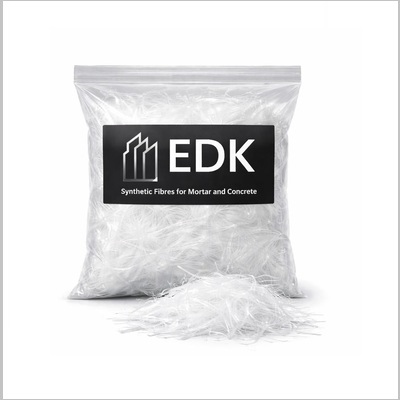
Monofilament Polypropylene Micro Fibers for Concrete and Mortar
Advanced monofilament polypropylene micro fibers engineered to prevent plastic shrinkage and plastic settlement crack formation in concrete and mortar systems through uniform crack distribution control and enhanced early-stage structural integrity.
Product Overview
These premium synthetic micro fibers deliver exceptional crack control performance in fresh concrete and mortar. Each fiber is engineered as a monofilament with precise dimensional specifications: 18 micrometers diameter and 6 millimeter length, optimized for uniform dispersion and maximum effectiveness. The specialized geometry and material composition inhibit the formation and coalescence of micro cracks induced by load-free processes such as plastic shrinkage and plastic settlement. The fibers reduce permeability through crack prevention and improve durability by maintaining concrete integrity during critical early-age curing phases. Superior adhesion to the cementitious matrix combined with excellent dispersibility ensures reliable performance across diverse concrete and mortar applications.
Recommended Applications
- Large-surface area field concretes, slabs, and covering concretes requiring crack control.
- Industrial floor systems and specialized flooring applications.
- Water structures and hydraulic applications requiring enhanced durability.
- Precast concrete elements and architectural façade panels.
- Slabs and floor systems for agricultural and infrastructure structures.
- Wet and dry sprayed concrete systems (shotcrete) applications.
- Fire-resistance improvement in concrete and mortar systems.
- Impact-resistant concrete elements including piling and impact-loaded structures.
- Extruded cementitious materials and specialized concrete products.
- Mortars and plasters for strengthening, reinforcement, and repair applications.
Advantages and Properties
- Significantly reduces plastic shrinkage and plastic settlement crack formation risk in fresh concrete and mortar.
- Improves fresh mixture cohesion and reduces bleeding through enhanced internal reinforcement.
- Reduces the number, width, and density of cracks at initial stages of hydration through controlled crack distribution.
- Improves durability by reducing permeability through elimination of micro-crack pathways and reduced crack networks.
- Excellent dispersibility throughout the cementitious matrix with superior adhesion providing long-term structural performance.
- Engineered monofilament fibers melt completely at approximately 180°C and are fully destroyed at around 350°C, eliminating potential voids in the concrete matrix.
- Remaining voids after fiber melting act as interconnected channels where heated and expanded air can escape without inducing internal stress or concrete spalling during fire exposure.
- Provides effective alternative to traditional crack control mesh reinforcement with superior workability and placement ease.
- Improves impact and abrasion resistance of concrete through enhanced crack prevention and structural continuity.
- Enhances flexural strength of concrete slabs and reduces surface damage through improved structural integrity.
- Prevents spalling during freeze-thaw cycles through reduced crack pathways and improved material homogeneity.
- Micro fibers remain invisible on concrete surfaces, providing enhanced aesthetic properties without visual fiber exposure.
- Corrosion-free composition ensures no reinforcement degradation or durability concerns across all exposure environments.
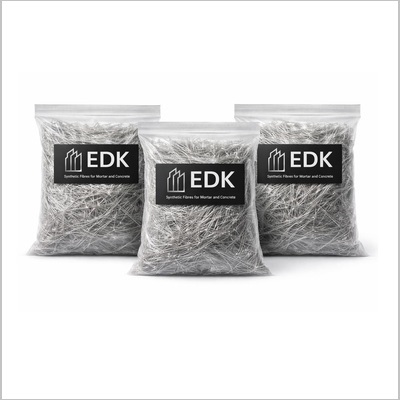
Macro-Synthetic Monofilament Copolymer Fiber for Concrete
Advanced monofilament copolymer macro fiber engineered to reduce crack density and width while preventing plastic shrinkage and plastic settlement crack risk in concrete through enhanced structural reinforcement and energy absorption during early-age hydration.
Product Overview
This engineered monofilament macro synthetic fiber is formulated with optimized copolymer chemistry to provide superior crack control and structural reinforcement in concrete. The fiber geometry and material composition are engineered to provide comprehensive performance: significantly reduces plastic shrinkage and plastic settlement crack formation risk, improves energy absorption capacity through enhanced matrix reinforcement, enhances flexural performance and load-bearing characteristics, and improves overall concrete durability through crack density and width reduction. The macro fiber dimensions and strength characteristics enable effective dispersal throughout concrete mixtures, providing reliable long-term reinforcement performance comparable to traditional steel mesh while offering superior workability, placement ease, and corrosion resistance benefits.
Recommended Applications
- Large-area slab-on-grade concrete and structural slabs requiring crack control.
- Industrial slab applications and specialized flooring systems.
- Parking lots and loading areas requiring impact and abrasion resistance.
- Precast panel, façade, and wall element production.
- Concrete canals, precast concrete saddles, and water structures.
- Agricultural structure slabs and ground concrete applications.
- Structural reinforcement where traditional steel mesh replacement is desired.
- Applications requiring enhanced load distribution and impact resistance.
Advantages and Properties
- Significantly reduces plastic shrinkage and plastic settlement crack formation risk in concrete.
- Increases the energy-absorbing capacity of concrete through enhanced internal structural reinforcement.
- Enhances flexural performance and load-bearing characteristics of hardened concrete.
- Improves concrete durability by reducing and limiting crack formation density and width at all stages.
- Improves fire resistance characteristics of concrete systems.
- Increases impact and abrasion resistance properties of concrete.
- Improves cohesiveness of fresh concrete and reduces bleeding during initial placement.
- Reduces or eliminates the requirement for steel mesh reinforcement in many applications.
- Superior workability and placement characteristics compared to traditional steel fiber and mesh reinforcement.
- Excellent dispersibility throughout concrete mixture enabling uniform reinforcement distribution.
- Corrosion-free composition eliminates reinforcement degradation and durability concerns across all exposure environments.
- Long-term mechanical property retention without degradation from environmental exposure or time.
- Cost-effective reinforcement alternative to traditional steel mesh with enhanced performance benefits.